Over two centuries ago two brothers sent humans flying for the first time. As Chris Stokel-Walker finds, their achievement is still celebrated today.
You have to try hard to get recognition in a family of 16 siblings, which might well explain why those with brothers and sisters tend to invent things. James Dyson hasadmittedbeing in constant competition with his siblings. Airplanes were invented by the Wright Brothers; film by Auguste and Louis Lumière.
And two sons of the 16 children born to Pierre Montgolfier and Anne Duret in Annonay, France, invented modern flight in a hot-air balloon. Children numbers 12 and 15 — Joseph and Etienne — combined their considerable knowledge to send a man, untethered, into the sky, for the first time ever on November 21, 1783.
Since then the township of Annonay (current population, 17,000) has celebrated the Montgolfiers’ achievement. “Annonay has very much been the cradle of hot-air ballooning since 1783,” Roland de Montgolfier, a local resident and member of the 44-strongLes Montgolfières d’Annonay ballooning club, writes in an email.
The brothers’ achievement was historic. The product of their work was the subject ofa question onJeopardyin March 2006. The French word for hot-air balloon that de Montgolfier uses — montgolfière — nods directly to their part in the history of manned flight even today.
The two were sons of a papermaker, and began experimenting with prototype balloons after the elder sibling, Joseph, noticed his laundry being pushed up above the licks of an open fire. In late 1782, the brothers lost control of one experimental balloon. Six months later near midsummer, they showed the product of their work to the people of Annonay. But no one was inside the basket.
As 1783 progressed, they carried out small test flights. Initially, they were unmanned; then a duck, a rooster, and a sheep were shepherded into the basket as makeweights. Finally, by fall, the Montgolfiers were confident enough to first attempt a tethered, then untethered flight.
When excitement about the new technology grew, the brothers’ experiments moved to the French capital.West of Paris at around 2 p.m. on November 21, the balloon, carrying François Laurent, the Marquis d’Arlandes, and science teacher Jean-François Pilâtre de Rozier, rose into the air. Initially the gathered crowd were speechless — for good reason.
“You are doing nothing and the balloon is scarcely rising a fathom,” D’Arlandes recalled de Rozier saying to him, according to a written account of the flight. “Pardon me,” d’Arlandes replied, before stoking the balloon’s fire. And with that, the contraption rose.
Flights of fancy
The dreams of flight seem to date to the earliest myths. Daedalus was drawn by the lure of touching the sky; his apogee was just too high. In the 13th century Roger Bacon let his imagination lead his pen over paper in drawing a “flying-machine,” “a suit of wings made to strike the air like those of a bird.” Five hundred years later John Wilkins, a philosopher, dreamt up “a flying chariot” with which man might make The Discovery of a World in the Moone. Leonardo da Vinci’s ornithopter is perhaps the best-known hypothetical flying machine.
Benjamin Franklin’s account / via Library of Congress
But it took until 1783 truly to take to the skies. When the Montgolfiers managed to get airborne, it inspired many. Word got back to England’s Monthly Review later that year, with its editorial board noting that in the news “we found our imaginations warmed by the gigantic idea of our penetrating some day into the wildest and most inhospitable regions of Africa, Arabia, and America, of our crossing chains of mountains hitherto impervious, and ascending their loftiest summits, of our reaching either of the two poles and in short, of our extending our dominion over the creation beyond any thing of which we have now conception.”
Benjamin Franklin was present in Paris that November day watching the test flight in his role as ambassador to France. He wrote to Sir Joseph Banks, the Royal Society President in London, of what he saw:
Its bottom was open and in the middle of the opening was fixed a kind of basket grate, in which faggots and sheaves of straw were burnt. The air, rarefied in passing through this flame, rose in the balloon, swelled out its sides, and filled it.
The persons, who were placed in the gallery made of wicker and attached to the outside near the bottom, had each of them a port through which they could pass sheaves of straw into the grate to keep up the flame and thereby keep the balloon full.
One of these courageous philosophers, the Marquis d’Arlandes, did me the honor to call upon me in the evening after the experiment, with Montgolfier, the very ingenious inventor. I was happy to see him safe. He informed me that they lit gently, without the least shock, and the balloon was very little damaged.”
All told, the balloon, 70 feet high, 46 feet across, and holding 60,000 cubic feet of hot air, had managed to fly 30,000 feet in a little less than 30 minutes.
Roland de Montgolfier plays down the event when we exchanged email prior to the anniverary, writing that in Annonay nothing special was planned to commemorate the anniversary. Except, he notes, “that we’ll greet a Polish team bringing a replica of the first human-bearing balloon.
“We’ll fly with them, of course.”
Chris Stokel-Walker is a UK-based freelance writer for the Economist, Tumblr, and BuzzFeed. He still can’t quite believe he’s getting paid to do professionally what he’s spent the 23 previous years of his life doing for free: finding a topic he knows nothing about (but which holds interest), immersing himself in it, then telling everyone who’ll listen about what he’s learnt.
Chris is a regular contributor to The Magazine, a fortnightly electronic periodical with long-form articles of interest to curious people with a technical bent. His most recent feature was about the business and lifestyle of body-part models.
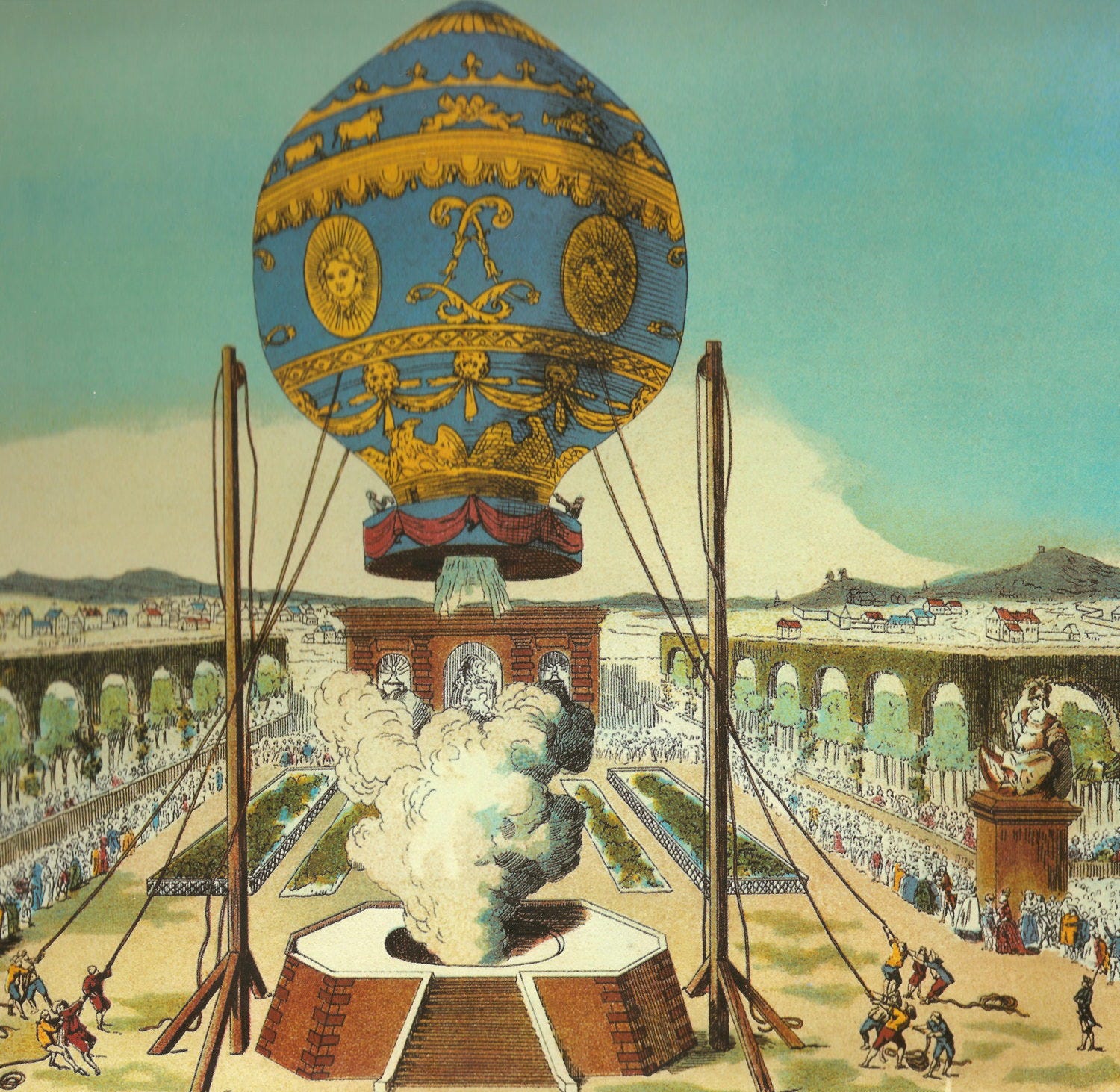
Banner image: The first manned hot-air balloon, designed by the Montgolfier brothers, takes off from the Bois de Boulogne, Paris, on November 21, 1783. Bildarchiv Preussuscher Kulturbesitz, Berlin. Via Wikicommons.
Over two centuries ago two brothers sent humans flying for the first time. As Chris Stokel-Walker finds, their achievement is still celebrated today.
You have to try hard to get recognition in a family of 16 siblings, which might well explain why those with brothers and sisters tend to invent things. James Dyson has admitted being in constant competition with his siblings. Airplanes were invented by the Wright Brothers; film by Auguste and Louis Lumière.
And two sons of the 16 children born to Pierre Montgolfier and Anne Duret in Annonay, France, invented modern flight in a hot-air balloon. Children numbers 12 and 15 — Joseph and Etienne — combined their considerable knowledge to send a man, untethered, into the sky, for the first time ever on November 21, 1783.
Since then the township of Annonay (current population, 17,000) has celebrated the Montgolfiers’ achievement. “Annonay has very much been the cradle of hot-air ballooning since 1783,” Roland de Montgolfier, a local resident and member of the 44-strong Les Montgolfières d’Annonay ballooning club, writes in an email.
The brothers’ achievement was historic. The product of their work was the subject of a question onJeopardy in March 2006. The French word for hot-air balloon that de Montgolfier uses — montgolfière — nods directly to their part in the history of manned flight even today.
The two were sons of a papermaker, and began experimenting with prototype balloons after the elder sibling, Joseph, noticed his laundry being pushed up above the licks of an open fire. In late 1782, the brothers lost control of one experimental balloon. Six months later near midsummer, they showed the product of their work to the people of Annonay. But no one was inside the basket.
As 1783 progressed, they carried out small test flights. Initially, they were unmanned; then a duck, a rooster, and a sheep were shepherded into the basket as makeweights. Finally, by fall, the Montgolfiers were confident enough to first attempt a tethered, then untethered flight.
When excitement about the new technology grew, the brothers’ experiments moved to the French capital. West of Paris at around 2 p.m. on November 21, the balloon, carrying François Laurent, the Marquis d’Arlandes, and science teacher Jean-François Pilâtre de Rozier, rose into the air. Initially the gathered crowd were speechless — for good reason.
“You are doing nothing and the balloon is scarcely rising a fathom,” D’Arlandes recalled de Rozier saying to him, according to a written account of the flight. “Pardon me,” d’Arlandes replied, before stoking the balloon’s fire. And with that, the contraption rose.
Flights of fancy
The dreams of flight seem to date to the earliest myths. Daedalus was drawn by the lure of touching the sky; his apogee was just too high. In the 13th century Roger Bacon let his imagination lead his pen over paper in drawing a “flying-machine,” “a suit of wings made to strike the air like those of a bird.” Five hundred years later John Wilkins, a philosopher, dreamt up “a flying chariot” with which man might make The Discovery of a World in the Moone. Leonardo da Vinci’s ornithopter is perhaps the best-known hypothetical flying machine.
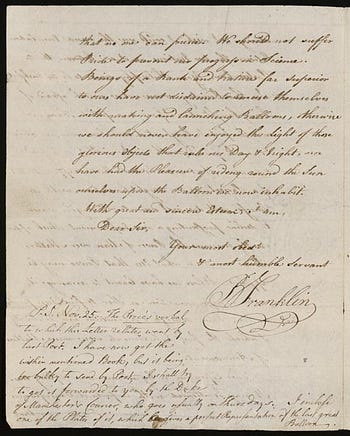
Benjamin Franklin’s account / via Library of Congress
But it took until 1783 truly to take to the skies. When the Montgolfiers managed to get airborne, it inspired many. Word got back to England’s Monthly Review later that year, with its editorial board noting that in the news “we found our imaginations warmed by the gigantic idea of our penetrating some day into the wildest and most inhospitable regions of Africa, Arabia, and America, of our crossing chains of mountains hitherto impervious, and ascending their loftiest summits, of our reaching either of the two poles and in short, of our extending our dominion over the creation beyond any thing of which we have now conception.”
Benjamin Franklin was present in Paris that November day watching the test flight in his role as ambassador to France. He wrote to Sir Joseph Banks, the Royal Society President in London, of what he saw:
Its bottom was open and in the middle of the opening was fixed a kind of basket grate, in which faggots and sheaves of straw were burnt. The air, rarefied in passing through this flame, rose in the balloon, swelled out its sides, and filled it.
The persons, who were placed in the gallery made of wicker and attached to the outside near the bottom, had each of them a port through which they could pass sheaves of straw into the grate to keep up the flame and thereby keep the balloon full.
One of these courageous philosophers, the Marquis d’Arlandes, did me the honor to call upon me in the evening after the experiment, with Montgolfier, the very ingenious inventor. I was happy to see him safe. He informed me that they lit gently, without the least shock, and the balloon was very little damaged.”
All told, the balloon, 70 feet high, 46 feet across, and holding 60,000 cubic feet of hot air, had managed to fly 30,000 feet in a little less than 30 minutes.
Roland de Montgolfier plays down the event when we exchanged email prior to the anniverary, writing that in Annonay nothing special was planned to commemorate the anniversary. Except, he notes, “that we’ll greet a Polish team bringing a replica of the first human-bearing balloon.
“We’ll fly with them, of course.”
Chris Stokel-Walker is a UK-based freelance writer for the Economist, Tumblr, and BuzzFeed. He still can’t quite believe he’s getting paid to do professionally what he’s spent the 23 previous years of his life doing for free: finding a topic he knows nothing about (but which holds interest), immersing himself in it, then telling everyone who’ll listen about what he’s learnt.
Chris is a regular contributor to The Magazine, a fortnightly electronic periodical with long-form articles of interest to curious people with a technical bent. His most recent feature was about the business and lifestyle of body-part models.
Banner image: The first manned hot-air balloon, designed by the Montgolfier brothers, takes off from the Bois de Boulogne, Paris, on November 21, 1783. Bildarchiv Preussuscher Kulturbesitz, Berlin. Via Wikicommons.
your chance to get 750$ to your paypal account ou can grab a $750 PayPal gift card now. Do you frequently locate your self scrimping for your cash? Has your monetary state of affairs turn out to be so determined which you do not actually have sufficient to shop for for groceries or your kid's college needs? Well, fear now no longer for the answer for your troubles may be yours with only a click on of the mouse. The solution for your monetary catch 22 situation is for you to shop for present playing cards. Well, now no longer actually purchase them -maximum playing cards are unfastened. You might not should shell out massive quantities of cash; you simplest want to comply with sure commands or guidelines and spend numerous mins in the front of the pc each unmarried day. Cards had been first utilized in 1994 through Blockbuster Entertainment in area in their common present certificates. The concept stuck on and present playing cards a...
100 BEST NETFLIX SERIES TO WATCH RIGHT NOW (DECEMBER 2022) Looking for the best shows on Netflix? Look no further, because Rotten Tomatoes has put together a list of the 100 best original Netflix series available to watch right now, ranked according to the Tomatometer. To keep the list fresh with the best Netflix series to watch, the series featured here are currently in production, have been renewed for further seasons, or aired their final episode recently (within the last year or two, so people can still discover them after they’ve ended). The most popular shows ranking on our guide to the best-reviewed on Netflix include Stranger Things (which aired its fourth season in 2022), phenom Squid Game (which will air its second season in 2023 or 2024), video game curse-breaking adaptations ( Arcane: League of Legends , The Witcher , Cyberpunk: Edgerunners ), crime dramas ( Ozark and Peaky Blinders , which both concluded in April 2022), royal ...
Welcome to ScienceOpen version 2.017 January 3, 2017 Author: Jon Tennant Kick off the new year with the new unified search on ScienceOpen! We have accomplished a lot over the last year and are looking forward to supporting the academic community in 2017. In 2016 ScienceOpen brought you more context: Now your search comes with a new analytics bar that breaks down your search results by collections, journals, publishers, disciplines, and keywords for quicker filtering. Try a search for the pressing topics of 2016 like Zika or CRISPR and take the new features for a spin. Researcher output, journal content, reference lists, citing articles can all be dynamically sorted and explored via Altmetric score, citations, date, activity. Statistics for journals, publishers and authors give overview of the content that we are indexing on ScienceOpen. Check out the most relevant journals on ScienceOpen, for example BM...

Comments
Post a Comment